
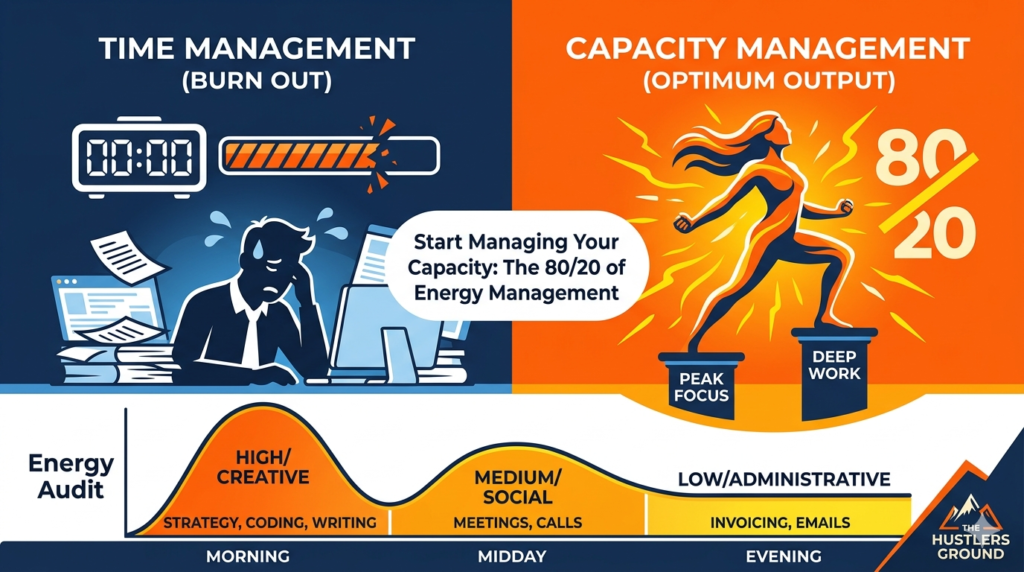
We’ve all heard the cliché: “You have the same 24 hours in a day as Beyoncé (or Elon Musk, or Jeff Bezos).” It’s meant to be inspiring, but it’s actually a fundamental lie. While the clock ticks the same for everyone, our capacity to fill those hours is vastly different. If you are a founder, a freelancer, or a high-performer at The Hustlers Ground, you know that one hour of “deep work” is worth five hours of “busy work.”
The secret to elite output isn’t squeezing more minutes out of your day—it’s about applying the Pareto Principle (the 80/20 Rule) to your internal battery.
Why Time Management is a Trap
Time management treats you like a machine. It assumes that an hour at 8:00 AM is identical to an hour at 4:00 PM. But humans are biological, not mechanical. We have “circadian rhythms”—natural peaks and valleys in alertness.
If you spend your high-octane morning energy answering mundane emails and your “brain fog” afternoon trying to solve your business’s biggest strategic problems, you are leaking profit. You’re using a Ferrari to haul gravel and a tricycle to win a race.
The Energy Audit: Mapping Your Peak Capacity
To stop the leak, you need to conduct an Energy Audit. This isn’t about what you do, but when you do it. By aligning your hardest tasks with your highest energy, you achieve the 80/20 result: 80% of your progress coming from the 20% of your most energized time.
| Time Block | Energy Level | Ideal Task Category | Examples |
| Morning (Peak) | High / Creative | Deep Work | Coding, strategy, writing, complex problem solving. |
| Mid-day (Lull) | Medium / Social | Collaborative Work | Meetings, networking, team syncs, lunch. |
| Evening (Taper) | Low / Admin | Shallow Work | Invoicing, emails, filing, scheduling, data entry. |
1. Protect the “Golden Window”
For most, the first 3–4 hours of the day are the “Golden Window.” This is when your willpower is highest and your distractions are lowest. Rule of thumb: Do not open Slack or Email until your most important task (MIT) is done.
2. Leverage the Mid-day Slump
Around 2:00 PM, most people experience a dip in glucose and focus. Instead of fighting it with a third cup of coffee, pivot. Use this time for tasks that require human connection rather than intense logic. Meetings actually provide a social “jolt” that can carry you through the slump.
3. The “Taper” Close-out
Use your lowest energy state for “maintenance mode.” This is when you handle the chores of business. It requires zero creativity to pay an invoice or organize a folder, so don’t “waste” your morning brainpower on it.
The Hustler’s Protocol: Two Rules for Immediate Efficiency
To make this system stick, you need two “guardrail” rules to manage the daily influx of tasks:
- The 2-Minute Rule: If a task takes less than 120 seconds (like a quick “yes/no” reply or a file upload), do it the moment it hits your radar. This keeps your mental “cache” clear.
- The 20-Minute Block: If a task requires more than 20 minutes of deep thought, it is officially “Deep Work.” Do not try to squeeze it into a gap between meetings. Move it to your Morning Peak zone.
The Bottom Line
High performance isn’t about being “busy” from 9 to 5. It’s about being effective when it matters most. When you stop managing your time and start managing your capacity, you stop feeling drained and start feeling dangerous.
Are you ready to audit your energy? Start tomorrow: Move your hardest task to your earliest hour.